
Frequently asked questions
The questions importers and end customers ask most — answered from real-world installation and after-sales experience across Europe and North America.
Fitting a shower toilet or bidet seat
Can a bidet seat be installed on an existing toilet?
Yes. Seats retrofit onto most standard bowls: a T-valve taps into the existing water supply, and electric models need a nearby socket. Typical installation takes 10–30 minutes with basic tools and no plumbing renovation. Wall-hung shower toilets are the exception — they require a support frame.
Do wall-hung shower toilets fit standard support frames?
Yes. Wall-hung models mount on any in-wall frame with 180 mm fixing centres — Geberit Duofix, TECE and equivalent systems are the European standard. A building-preparation drawing is included in the technical file.
Can it be installed where the cistern is already tiled in?
If an angle valve is accessible, connect with the supplied T-piece — one side feeds the cistern, the other feeds the shower toilet. For fully tiled-in cisterns, a universal connection set is available.
DIY or professional installation?
Seats are designed for skilled DIY — manuals and installation videos are provided. Local regulations may require a licensed plumber (for example, bidet installation is notifiable plumbing work in parts of Australia). Wall-hung toilets install like conventional wall-hung units.
What the product needs from your water
What water pressure is required?
City mains pressure of approximately 3 bar is recommended; below about 2 bar the nozzles may not deploy fully and the spray weakens. Mains pressure is required — gravity or tank-fed supply will not work correctly.
Do I need a hot water connection?
No. Electric models heat water instantly with a tankless ceramic heater — unlimited warm water with zero standby power and no storage tank. Connecting a hot-water line is not supported; the unit is designed for cold water only.
Can well or spring water be used?
No — only drinking-water quality. Untreated water deposits iron, manganese and limescale in valves and fine nozzles, and carries a microbiological risk. Use with non-potable water voids the warranty.
How much water does a wash use?
About 0.6–0.7 litres per wash cycle — far less than the water embedded in a toilet paper roll (roughly 178 litres per roll). Combined with low-consumption flushing, water use per visit drops to 3–6 litres versus 6–9 litres conventionally.
Power for electric models
What electrical connection is needed?
European models: a 220–240 V earthed socket, ideally on a dedicated circuit — never a multi-socket extension. North American models: a 120 V GFCI-protected outlet within about 1 m (3 ft) of the toilet.
Are bathroom sockets regulated?
Yes. For example, French standard NF C 15-100 requires sockets more than 60 cm from shower or bath. Always have electrical installation done by a professional who knows the local code.
What happens in a power cut?
The toilet remains fully usable as a normal toilet — flushing still works. Only the electronic functions (wash, dryer, heated seat) pause until power returns.
How much electricity does it consume?
The tankless heater draws only during use. Typical consumption is 0.5–1 kWh per day for a full-featured unit (around €45 per year at €0.25/kWh), and eco modes reduce this by 30–50%. Heated-seat eco mode heats only when a user is seated.
Standards, backflow protection and market entry
What is EN 1717 and why does it matter?
EN 1717 is the European standard that protects drinking water from backflow contamination. OtterMax designs the backflow protection into the ceramic water path from the start of design — one of only 2–3 factories in China doing this. Most competitors add an external check valve afterwards. Surprisingly, almost no European retailer or brand publishes EN 1717 guidance — we make it part of the product.
What certifications do OtterMax products carry?
European market: CE, CB, EN 1717, EN 13077, RoHS, REACH. North American market: ETL, cETL, FCC. Full technical files — test reports and declarations of conformity — are shipped with every order.
Is backflow protection required outside Europe?
Yes, in different forms. In North America, an anti-siphon device (vacuum breaker) is standard practice on bidet seats. In Australia, high-hazard backflow prevention per AS/NZS 2845.1 and WaterMark certification are mandatory for compliant installation — one of the reasons AU installation is regulated plumbing work.
Keeping the product at its best
How does the nozzle stay hygienic?
The nozzle extends only during use and retracts into the housing afterwards. It self-rinses with clean water before and after every wash, and antibacterial materials are used for spray arms and heads. Nozzles are replaceable.
How do I clean the nozzle deeply?
Shut off the water, run the self-clean purge, unclip the nozzle, soak it 10 minutes in white vinegar, rinse and reassemble. Do this monthly in hard-water areas.
Hard water — do I need a filter?
An inline pre-filter is strongly recommended where water is hard (total hardness above 30°). Change it every 2–3 months, and at least twice a year in hard-water areas. Filters reduce scaling but do not replace descaling.
How often should I descale?
Every 6–12 months depending on water hardness, using a standard coffee-machine descaler. Some models include an automatic descaling program. Limescale damage is not covered by warranty.
Which cleaning products should I avoid?
Never use bleach, chlorine, acids, abrasive creams, acetone, solvent sprays or alcohol-based products — they cause permanent staining and damage. Use a mild pH-neutral cleaner with a soft cloth.
What the 2-year standard covers
What warranty applies?
Two years is the industry standard across Europe and North America, covering manufacturing defects with workshop-return service. As an OEM partner you can set your own brand-level warranty terms — our modular design keeps repair costs predictable.
What is not covered?
Limescale damage, use with non-potable water, misuse, and damage from improper installation or electrical work. These exclusions match the published policies of European and US brands.
How are spare parts handled?
OtterMax's modular architecture means most repairs are module swaps — control board, heater, valve, nozzle assemblies. We provide OEM partners with a documented spare-parts strategy and full technical documentation so your local service team can repair in the field.
Shower toilet, bidet seat, wall-hung or floor-standing
Shower toilet or bidet seat?
A shower toilet has the wash nozzle built into the ceramic: cleaner design, standard seat dimensions, hidden water and power connections, and easier maintenance. A bidet seat retrofits an existing bowl: more affordable, removable, and ideal for rentals — but with visible connections and compatibility limits from the existing bowl.
Wall-hung or floor-standing?
Wall-hung is more elegant and makes floor cleaning easy, but needs an in-wall frame and concealed cistern — best planned for new builds and renovations. Floor-standing is simpler to install and retrofit into an existing bathroom.
Suitable for children and elderly users?
Yes. Child mode reduces water pressure and temperature to safe levels, and seat sensors can be configured to ignore light users. For elderly users, automated wash-and-dry improves independence and hygiene with no effort or bending.
Are there health benefits?
Water cleaning is gentler and more effective than paper — recommended for hemorrhoids, sensitive skin and post-partum care; the front wash helps prevent UTIs. Warm water liquefies fats and dissolves residue without friction, protecting the skin barrier.
Does it really save toilet paper?
A basic wash eliminates roughly 70–80% of paper use; with the warm-air dryer, usage approaches zero. An average person uses about 134 rolls per year — the economics improve with household size.
Daily use, remote control, wash modes and user profiles
Do I have to press the flush button after using the wash function?
Yes. The wash and flush functions are independent. After a wash cycle, press the small or large flush button on the actuator plate to rinse the bowl — flushing does not start automatically.
What is the oscillating wash?
The spray nozzle moves back and forth during the wash cycle, increasing the area cleaned. It is selectable on most models via the remote or side knob.
What is the pulsating wash?
The spray alternates between stronger and softer intensity, which many users find more comfortable for sensitive use cases. It combines with the oscillating function on most platforms.
What is the difference between standard and feminine wash?
Standard wash sprays from the rear nozzle opening for posterior cleansing. Feminine wash sprays from the front opening at a wider angle, designed for female anatomy.
Can water temperature and pressure be adjusted?
Yes. Water temperature is adjustable across five levels (approximately 32–40 °C), and spray pressure has multiple levels. Adjustments are made from the remote control or the side knob on the unit.
Can the spray nozzle be removed for cleaning?
Yes. The nozzle extends on demand from the manual-cleaning function and unclips without tools for rinsing under running water. It retracts automatically after cleaning.
How do I know the spray nozzle is hygienic?
The nozzle self-rinses with clean water before and after every wash, and again when the manual-cleaning function is run. Antibacterial materials are used in the spray tip. The tip is replaceable as a spare part.
What is the night-light used for?
A low-level LED inside the bowl makes the toilet easy to find at night without turning on bright bathroom lighting. It can be set to off, on, or auto (only in low ambient light).
Will the water scald the user?
No. The tankless ceramic heater delivers water at a maximum of approximately 40 °C. The unit has multiple safety cut-outs and the temperature control has five settings for predictable comfort.
Are spare parts available after the warranty period?
Yes. Soft-close hinges, seats, lids, remote controls, nozzle tips and actuators are stocked as spare parts and can be ordered through the OEM partner who supplied the unit. Full spare-parts catalogues are part of the partner documentation package.
How long does a wash cycle last?
Standard cycles run for roughly two to three minutes depending on model and function. Cycles end automatically, but can be stopped manually at any time with the STOP button on the remote.
Field-experience patterns from our service team — diagnostic direction, not step-by-step repair
What does it mean when the ambient light is flashing?
A flashing ambient light is our diagnostic channel: the unit self-reports the fault category by counting flashes in a repeating pattern. Two flashes indicate an outlet-side water sensor fault; three flashes an inlet-side water sensor; four flashes outlet water over-temperature; five flashes heater-module communication; six flashes seat temperature sensor open or short circuit; seven flashes seat over-temperature; eight flashes ambient temperature sensor; nine flashes dryer motor; ten flashes no water supply. Our engineering team has catalogued each pattern across thousands of field service tickets, which is why our partners receive the full diagnostic chart as part of the technical file.
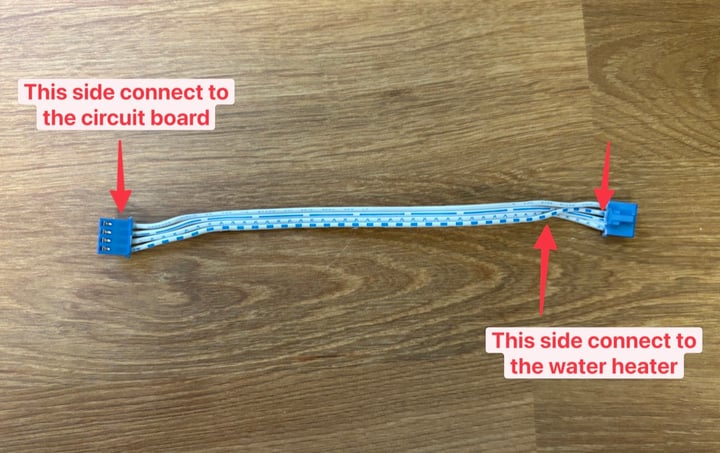 Diagnostic reference photo of internal wiring harness
 The cover or seat opens and closes by itself repeatedly. What direction should we look?
After our service team analysed repeated field tickets, three directions account for almost all cases: (1) control-board firmware state — usually resolved by a full power cycle, (2) the infrared auto-open sensor picking up stray reflections near the bowl, (3) the remote control sending continuous signals — typically a worn or stuck button on the remote PCB. Identifying which of the three is the cause takes our field engineers about ten minutes with the right diagnostic checklist, which is shipped with every OEM partner documentation package.
Water is leaking or the pump runs intermittently. Where does the fault usually sit?
Across our service database, intermittent pump operation and external leakage around the base trace to the solenoid valve assembly in more than 80% of cases. Mineral buildup in the valve seat is the most common root cause in hard-water regions, followed by worn diaphragm seals in older units. Our OEM partners receive the valve-replacement procedure and recommended spares kit as part of the after-sales documentation.
The wash function does not respond. What is the diagnostic logic?
Our service playbook for non-responsive wash separates hardware and firmware causes in two steps. First, the seating sensor is verified — the wash function will not start without a confirmed user on the seat. Second, the water-pump assembly is isolated from the control loop. Both checks are described in detail in the partner service manual, and the seat sensor and pump are stocked as separate spare modules so a field technician can swap in under 30 minutes.
Night light flashes even after the user has set it to permanent off.
A persistent flash with night light disabled usually points to one of two subsystem interactions our engineers have documented: a power-supply interaction with the seat heater circuit, or a signal-line issue in the instant-heating water module. Both are field-diagnosable by an authorised service technician; the diagnostics tree is part of the OEM partner service package.
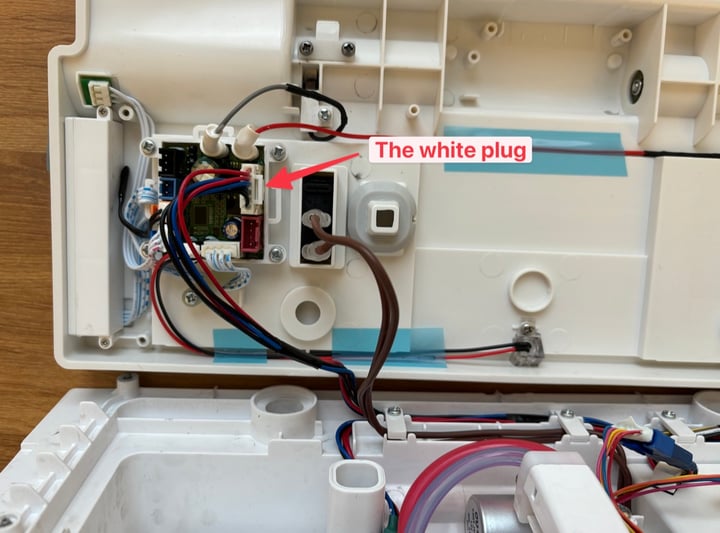 Field-service reference photo of internal transfer board and power connector
 Water pressure from the spray nozzle is weak. What does the diagnostic path look like?
Weak spray is one of the most common field complaints. Our service team classifies causes into three families: user-side adjustment (pressure setting at minimum), nozzle clog (mineral scaling on the spray tip), and supply-side pressure below 2 bar. Nozzle clogging is the dominant cause in regions with total hardness above 25°. The full triage procedure is part of the partner service manual.
Water temperature is too hot or too cold. What is the diagnostic starting point?
Always start by checking that the temperature setting is not pinned to an extreme value (1 or 5 on the five-step scale). If the setting is mid-range and the symptom persists, the cause is almost always one of: (1) a failing thermistor in the tankless heater module, (2) sustained low inlet water temperature reducing heat-exchange efficiency, (3) excessive scale on the heating element. All three are documented in the partner service manual with the recommended replacement part numbers.
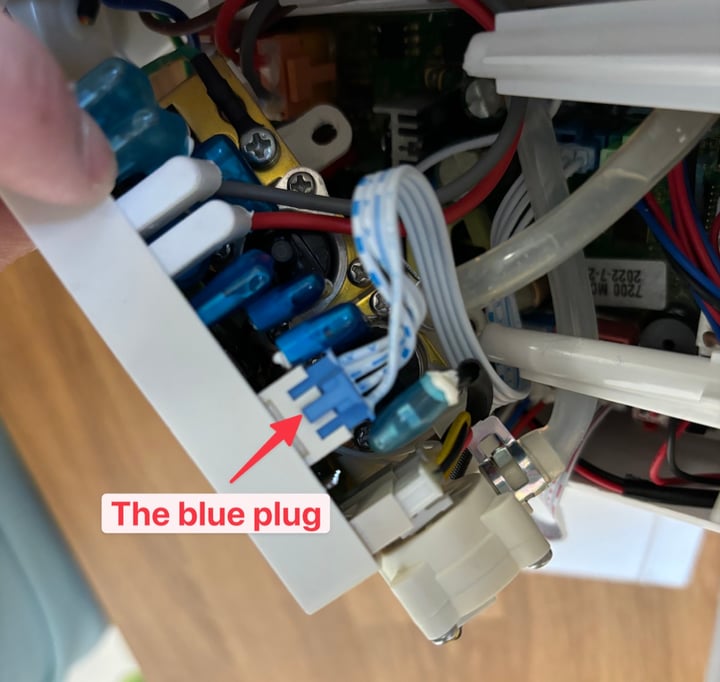 Field-service reference photo of instant-heating module signal connector
 The wash function does not start even though the power is on.
On our integrated-ceramic platforms, the wash and dry functions require the seating sensor to register a user. If the seat is unoccupied, the unit will not start the cycle. If the seat is occupied and the cycle still does not start, the cause is in the sensor-circuit or main control board — both are field-diagnosable with the partner service manual checklist.
Can end users repair a shower toilet themselves?
End users can perform only the simplest operations: cleaning the spray nozzle and replacing the soft-close seat or lid. All other service operations on water path, electrical, control and sensor subsystems must be carried out by an authorised service technician using OEM-supplied spare parts. This is consistent with the published service policies of leading European and North American shower-toilet brands.
What is the standard service-level expectation for warranty claims?
OtterMax operates a documented spare-parts strategy with our OEM partners. Standard modules — control board, instant heater, solenoid valve, sensor harness, nozzle assemblies — are stocked regionally by the partner, so most warranty service is completed within 48–72 hours of diagnosis. Critical-path modules that are not regionalised can be air-shipped from the factory within 5–7 business days. Full spare-parts catalogues and SLAs are part of the partner agreement.
What is the most common root cause of field service calls?
Our service data, drawn from tens of thousands of units shipped, places water-quality issues at the top: limescale damage to heating elements, solenoid valves and sensors in regions with total hardness above 25°. This is why every shower-toilet installation guide specifies an inline pre-filter and a 6–12 month descaling cycle — and why limescale damage is excluded from the standard warranty across the industry, not just our brand.
Where does the ambient-light flash pattern come from? Is it documented?
Yes. The flash-count diagnostic scheme is an OtterMax-engineered convention, developed after our service team noticed that field technicians were spending more time diagnosing than repairing. Each flash count maps to a specific subsystem, and the full mapping is shipped to OEM partners as a one-page laminated reference. It is one of the diagnostic conveniences that makes our service network measurably faster than competitors who rely on error codes hidden in a mobile app.
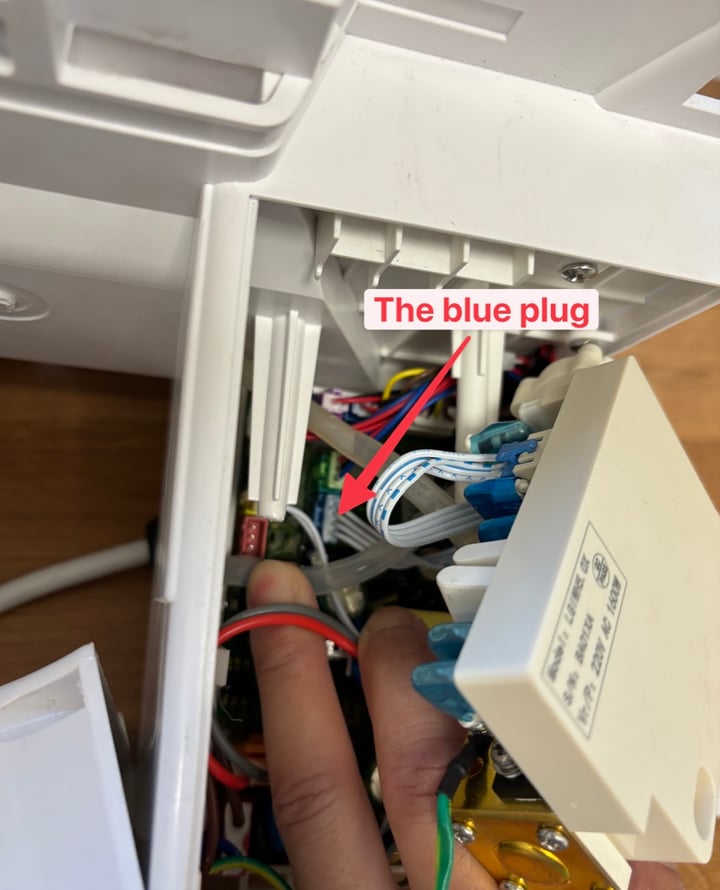 Field-service reference photo of second diagnostic connection point on the heating module
 Have a question we haven't answered?
Our engineering team answers technical questions directly — water pressure, frame compatibility, certification, OEM customisation. Contact us and we will reply within one business day.
Ready to build your next product line?
Tell us about your market and brand — we will recommend the right platform, walk you through certifications, and send a sample. Reply within one business day.